
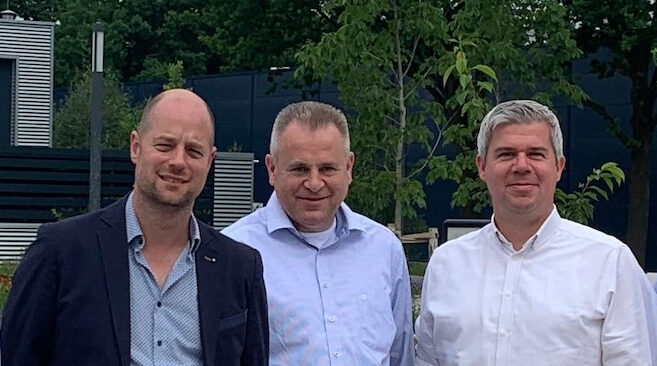
Over the past 1.5 years, a great deal of work has gone into finding solutions to grid congestion and making energy use more sustainable at Kennispark. Subsidies have now been awarded to help implement various solutions. Since January 2025, Jan Albert Westenbrink has been actively working at Kennispark on behalf of the local council to collaborate with a wider group of businesses on implementing these solutions.
-


-


-


-

 Delen
Delen
The primary aim is to offer existing and new businesses the prospect of sufficient transmission capacity on the existing local energy network. Under the working title ‘Kennispark Smart Energy System’, investment is being made in the local electricity network to establish a collective energy management system, combined with battery storage and renewable energy generation. All of this is being approached from the perspective of ‘what is possible’. Grants from Rabobank, Regio Deal 2 and the ERDF are helping the Kennispark Sustainability Cooperative to take significant steps towards a sustainable local energy economy.
RaboFonds
In 2025, the Kennispark Sustainability Cooperative was given a new lease of life. Under the cooperative’s first board, projects such as the ‘Solar on Roof’ scheme and the Solar Tree project were realised. Given the limited activities in 2024, the idea was to dissolve the co-operative, but the issues surrounding grid congestion – which are particularly relevant at present – have led to the co-operative continuing its work under a new board comprising Geert Wubben, Jeroen Zandstra and Gerrit Wemekamp.
Rabobank’s support of €5,000 was a welcome contribution.
Regio Deal 2: allocation of container battery and solar car park
Several years ago, the municipality of Enschede, the Sustainability Committee of Kennispark Entrepreneurs and the Kennispark area organisation submitted a Regio Deal application, which involved research into ways of tackling grid congestion and subsidising investment in energy generation and storage at Kennispark.
Grid congestion requires cooperation – both amongst ourselves and with the immediate surrounding area. The application included, amongst other things, funding for battery storage and solar car parks. The local generation and use of energy contributes to a sustainable and future-proof energy system. By using a battery, more generated solar power can be used locally, meaning it does not need to be fed back into the main grid. Generating sustainable electricity locally on a large scale is being achieved by installing solar panels above the car parks in the immediate vicinity of the Grolsch Veste and the IJsbaan – which form part of Kennispark. Supported by the Twente Board, 1.3 million euros has been allocated from the Regional Deal for the realisation of this project.
ERDF application ‘Energy storage and sharing’
In 2025, as part of the development and implementation of a smart energy system at Kennispark, an ERDF application was submitted on the initiative of the Area Organisation to invest in collective energy storage and sharing. In the first round of applications for this grant, the plan did not score highly enough to pass the selection committee’s assessment. Jan Albert: “This did not come as a real surprise to us, as we had to organise everything in a very short space of time in order to submit a robust and financially sound application”. In the second round, a robust project plan was drawn up based on the initial application. Leap, based at Kennispark, was brought in to provide support for both the first and second applications. The project plan involves the development and implementation of a smart energy system with storage, generation and control of electricity usage, and entails an investment of 3.5 million. A grant of 2 million has been awarded for this from the ERDF.
Jan Albert: “As part of my remit with the local authority, we had already started collecting energy consumption data so that we could draw up energy profiles based on that data. The ERDF grant ties in seamlessly with this, enabling us, together with the cooperative and based on the energy profiles, to form a consortium of companies. The consortium comprises Eurofins MASER, Pontus, Pure Stenen, Demcon, Pazo Vastgoed, New Origin and the Duurzaamheid Kennispark cooperative. This consortium is the first group with which we are investigating how we can allocate the available capacity on the grid as effectively as possible, precisely when a business actually needs it. By mapping this out properly and adapting the energy supply accordingly, it is possible to achieve a huge efficiency gain, and companies and property owners will ultimately gain more energy capacity for less money.”
Find out more about how we at Kennispark aim to make better use of peaks and troughs (in Dutch): Tubantia.nl.
Data is essential
Collecting data is an essential part of this. Jan Albert: “Only by collecting a great deal of data on companies’ energy consumption can you distribute the available electricity in the right and most efficient way. We don’t just look at the current situation; we also calculate how much electricity each company will need in the future. That starts behind the meter. Data can quickly provide insight into where savings can be made.”
In collaboration with Jan Albert and an expert in energy systems, the co-operative provides advice on how to reduce energy consumption, how to generate more energy yourself, and whether peak demand can be shifted to a different time.
Jan Albert: “There is still funding available from the Regio Deal to help businesses install individual solar carports above parking spaces on their own premises. We can advise on this, and a grant can be applied for to cover part of the cost of installing solar carports on their own premises. This is a good example of how the two grants awarded reinforce each other. With this form of solar carport, we can increase local energy generation, which is also part of the ERDF grant.”
Ambition
Jan Albert: “Our ambition is twofold: to invest in solutions for both before and after the meter. Behind the meter, businesses and property owners themselves have a great deal of influence and can therefore achieve significant energy savings – with or without subsidies. Ahead of the meter, thanks to the pilot project, we are working with the companies in the consortium to identify opportunities and bottlenecks and to invest in them in a targeted manner. We will then apply this knowledge in phases across the whole of Kennispark.
In addition to the technology, the relationships between participating businesses are a key focus. At Kennispark, we have not only physical neighbours but also what we call ‘network neighbours’. These are businesses connected to the same section of the energy network. This is determined by Enexis’s existing network structure. We are in discussions with Enexis to explore how we can ensure that energy and transmission capacity are used as efficiently as possible. Data is crucial here too, so we remain committed to gathering as much information as possible.”
Area Organisation
Jan Albert: “Partly thanks to the efforts of the area organisation, particularly during the initial phase, we have succeeded in securing these three grants. Furthermore, the knowledge about the companies and the contacts with both the companies and the property owners have been important in establishing the consortium and will be key in bringing the new clusters together in the future.”

