
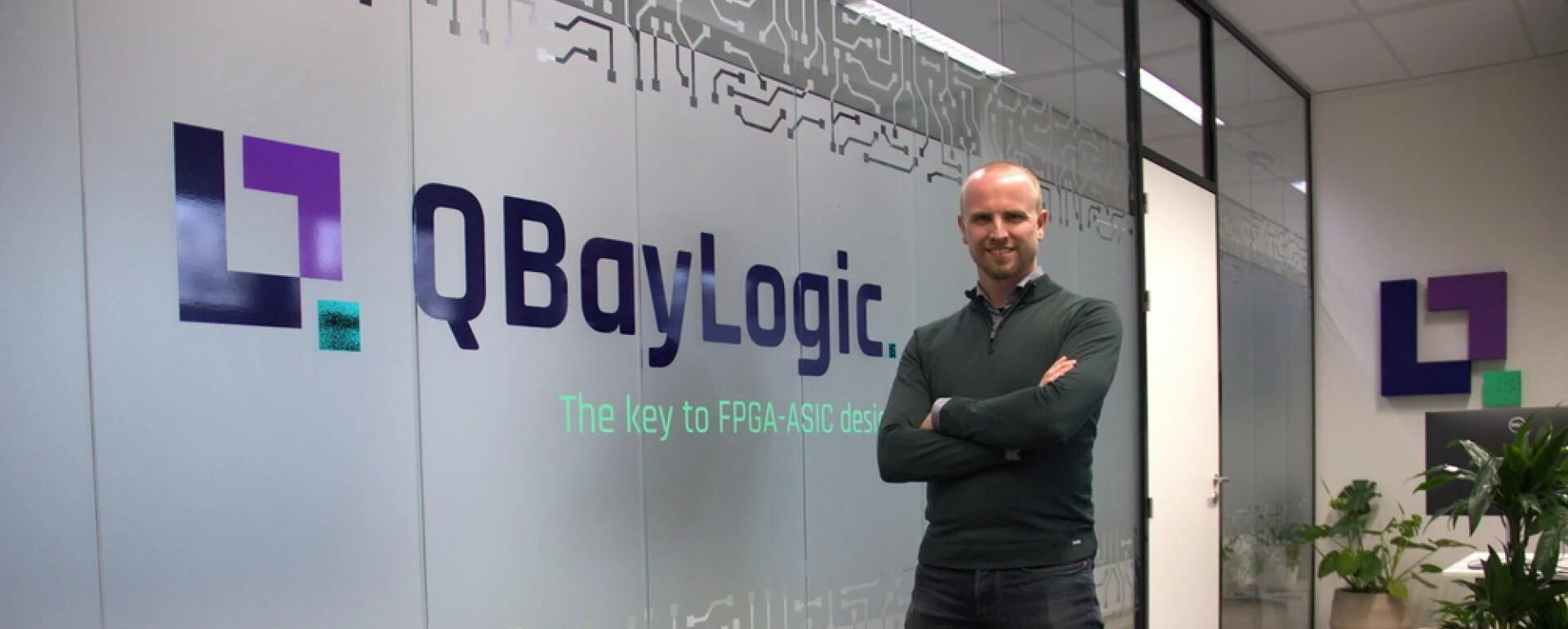
In a world where systems are required to respond ever more quickly and performance is becoming increasingly important, the chips in standard computers often fall short. This is particularly true when vast amounts of data need to be processed instantly. It is precisely in this arena that Kennispark-based QBayLogic operates.
-


-


-


-

 Delen
Delen
“Customers come to us with a major problem,” explains CEO Maarten Kuper. “And we design the solution for that customer in an FPGA (a programmable chip for specific tasks). In software, you’re essentially creating hardware. You see that classic separation in traditional chips. We mainly try to solve highly innovative or complex problems that require a real-time response.”
Origins at the University of Twente
QBayLogic has its roots at the University of Twente. Maarten’s father, Jan Kuper, was a lecturer and researcher there and, together with PhD student Christiaan Baaij, developed Clash. This is a compiler that translates functional languages into a hardware language.
When his father had to retire, they decided to start a company together to continue developing Clash. In 2021, almost six years after its foundation, Maarten joined the company. Shortly afterwards, he took over the reins completely. “When I joined, it was just engineers (technical specialists),” he says. “A truly scientific group of people doing wonderful things. My role was to transform that into a business.”
Solutions for extremely high performance
QBayLogic focuses on challenges where performance is crucial. Situations where a CPU (a computer’s central processing unit) or other standard chip simply cannot cope. Maarten gives an example: “Suppose you send a signal via a laser, for instance for communication. That signal gets disrupted by the air as it travels. At the receiving end, that signal must be corrected at lightning speed so that the information is accurate. It has to be adjusted so quickly based on what comes back that it’s almost impossible. That has to be done in an FPGA, because it can process much more data.” It is precisely in these kinds of complex, real-time applications that the company’s strength lies.
From a room at Demcon to an independent organisation
In recent years, QBayLogic has been working on further professionalisation. The company was initially based in an office space at Demcon, but later moved to its own premises in Enschede. Shares were also bought back and the organisation was further structured.
With 25 employees, including interns and working students, the team consists largely of engineers. In 2025, an HR department was added to focus more on the development and support of the team. “We are a service organisation,” says Maarten. “It’s all about your people. You have to look after them properly.”
Growing by staying small
The ambition is to grow to between 30 and 50 employees over the next five years. At the same time, QBayLogic wants to remain deliberately flat in its organisation. “For each project, you have a project lead who is functionally responsible. But apart from that, there are no managers in the organisation. It’s just very flat and equal here.” According to him, the challenge lies in maintaining the dynamism. “Growing big by staying small. Innovation happens when you’re all in the same room together. Working side by side, talking a lot, having a good time. That’s where it happens.” He also considers openness important. “People used to say: I keep work and private life separate. In my view, that doesn’t work. If something’s going on at home, you bring it to work. You need to be able to talk about it there.”
The next phase of growth
In recent years, QBayLogic has achieved strong results with a number of regular clients. Yet the company does not want to rest on its laurels. “If you only hold on to the clients who support you well, you become a bit complacent,” says Maarten. “We want to move from reactive to proactive.” To achieve this, a focus must be chosen.
Sectors such as Defence, Aerospace, data centres and Med Tech are being considered as key areas. The decision is still to be made. “We can’t say yet which sectors it will be, but we’re right in the middle of that process.”
Strongly rooted in Twente
The connection with Twente is self-evident. The founders came from the university and the company grew within the Kennispark ecosystem in Enschede. “We’re definitely recognised as a great company that you want to be part of,” says Maarten. He himself is active within Kennispark’s entrepreneurial network and involved in talent development. Although the clients operate internationally, Enschede remains the permanent base.
When asked what the greatest achievement is, Maarten doesn’t immediately mention a technical project. “The best thing is the culture here. How enthusiastic people are when they come in. Basically, everyone here sits at their desk with a smile. I really see that as a compliment to the work we do together.”
Source: Enschede.nl

